


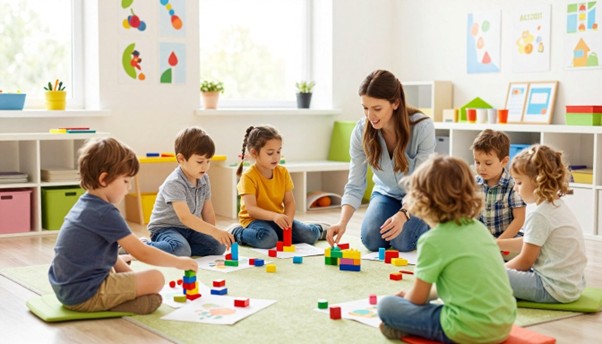
Engaging in preschool activities is crucial for young children’s cognitive, emotional, and physical growth. These activities not only stimulate their curiosity but also lay the foundation for future academic success.
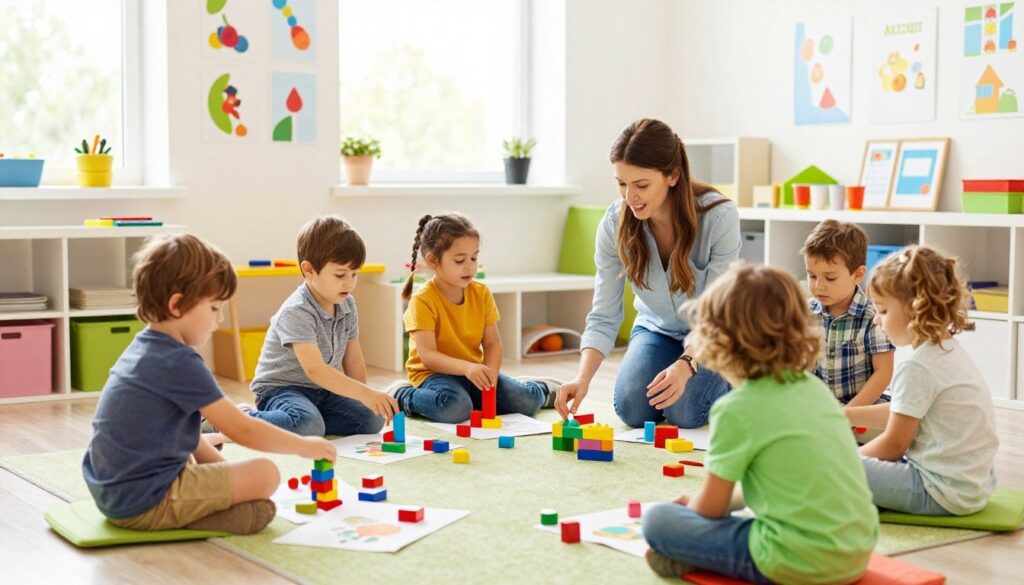
Learning through play is an effective way to introduce new concepts and skills, making it an integral part of a child’s early years. By incorporating a variety of fun and interactive activities, parents and caregivers can significantly enhance a child’s developmental journey.
Key Takeaways
- Preschool activities play a vital role in kids’ overall development.
- Learning through play is essential for cognitive and emotional growth.
- Interactive activities can enhance a child’s skills and introduce new concepts.
- Engaging preschool activities can lay the groundwork for future academic success.
- Parents and caregivers can significantly impact a child’s development through play.
Why Early Childhood Activities Matter for Development
The foundation of a child’s development is significantly influenced by early childhood activities. These activities are not just a form of entertainment but are crucial for laying the groundwork for future academic success and personal growth.
Early childhood activities are designed to stimulate a child’s mind and body, promoting overall development. Structured play, in particular, offers numerous benefits that can enhance a child’s cognitive abilities and social-emotional growth.
Cognitive Benefits of Structured Play
Structured play is a type of activity that is guided by adults or more experienced peers, providing children with the opportunity to develop their problem-solving skills, creativity, and critical thinking. Activities such as puzzles, building blocks, and strategy games are excellent examples of structured play that can improve cognitive function.
These activities challenge children to think creatively and come up with innovative solutions. For instance, building with blocks can enhance spatial awareness and mathematical skills, while puzzles can improve memory and concentration.
Social-Emotional Growth Through Activities
Early childhood activities also play a vital role in promoting social-emotional growth. Group activities and team sports help children develop essential social skills such as cooperation, communication, and empathy.
Moreover, activities that involve role-playing and storytelling can enhance emotional regulation and self-awareness. Children learn to express their feelings and understand the perspectives of others, fostering a sense of community and respect.
By engaging in a variety of early childhood activities, parents and caregivers can provide children with the tools they need to succeed in life. These activities not only promote cognitive development and social-emotional growth but also lay the foundation for a lifelong love of learning.
The Best Preschool Activities for Kids: A Comprehensive Guide
As a parent or caregiver, selecting the most suitable preschool activities for your child is essential for their cognitive, social, and emotional growth. Preschool activities should be tailored to the child’s age and developmental stage to maximize their learning potential.
Age-Appropriate Activity Selection
Choosing activities that are appropriate for your child’s age is crucial. For instance, younger preschoolers (3-4 years) benefit from simple, sensory-based activities like playdough, sand, and water play, while older preschoolers (4-5 years) can engage in more complex activities like puzzles, counting games, and basic literacy exercises.
Some key considerations when selecting age-appropriate activities include:
- Understanding your child’s developmental milestones
- Observing their interests and preferences
- Ensuring the activity is safe and engaging
Creating a Balanced Activity Schedule
A balanced activity schedule is vital to ensure that your child engages in a variety of experiences that promote overall development. A well-planned schedule should include a mix of:
- Structured activities, such as lessons and crafts
- Unstructured playtime, allowing for free exploration
- Indoor and outdoor activities to promote physical development
- Group and individual activities to foster social and emotional growth
To create a balanced schedule, consider the following tips:
- Alternate between high-energy and low-energy activities
- Include a range of activities that cater to different learning styles
- Be flexible and adjust the schedule as needed to accommodate your child’s changing needs
By following these guidelines and creating a balanced activity schedule, you can provide your child with a engaging and educational preschool experience that lays the foundation for future success.
Sensory Play Activities That Engage Multiple Senses
Sensory play is a vital component of childhood development, engaging children’s senses and fostering a deeper understanding of the world around them. Through sensory experiences, children develop their sensory awareness and integration, laying the groundwork for future cognitive and motor skills.
DIY Sensory Bins and Tables
Creating DIY sensory bins and tables is an engaging way to encourage sensory exploration. Fill bins with materials like rice, beans, or sand and hide small toys or other objects for children to discover. You can also create sensory tables with water, soap, and toys for a fun and educational water play experience.
To make a DIY sensory bin, you’ll need a container, fill material, and objects to hide and seek. For example, a moon sand sensory bin can be made with fine sand, glow-in-the-dark stars, and small toy space vehicles.
Texture Exploration Activities
Texture exploration is a critical aspect of sensory play, helping children develop their sense of touch. Activities can include playing with play dough, slime, or sand, and exploring different textures through touch.
- Play dough creations: Make or buy play dough and let children mold and shape it.
- Slime making: Create slime with glue, water, and borax for a fun and tactile experience.
- Sand play: Engage in sand play at the beach or in a sandbox, building castles and exploring textures.
Scent and Sound Discovery Games
Scent and sound discovery games add another dimension to sensory play, engaging children’s senses of smell and hearing. Activities can include scent matching games, sound exploration with musical instruments, or nature walks to discover new sounds and smells.
| Activity | Sense Engaged | Materials Needed |
| Scent Matching Game | Smell | Various scented objects or essential oils |
| Sound Exploration | Hearing | Musical instruments or sound-emitting objects |
| Nature Walk | Smell and Hearing | None |
By incorporating sensory play activities into daily routines, parents and educators can provide children with a rich and engaging environment that fosters development and creativity.
Fine Motor Skill Development Activities
Enhancing fine motor skills in early childhood lays the foundation for future writing and complex motor tasks. Fine motor skills involve the coordination of small muscles in the hands and fingers, which are crucial for performing tasks that require precision.
Beading and Lacing Projects
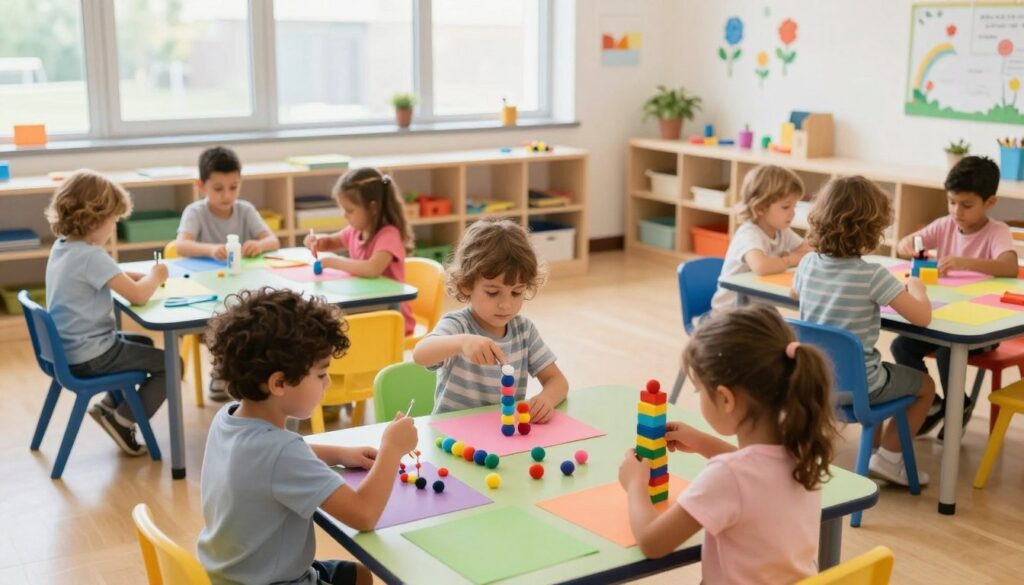
Beading and lacing projects are excellent activities for improving fine motor skills. These activities require children to manipulate small objects, threading beads onto a string or lacing through a pattern. This helps to develop hand-eye coordination and dexterity.
Examples of Beading and Lacing Activities:
- Threading beads onto a pipe cleaner
- Lacing a card with yarn or string
- Creating patterns with beads on a string
Cutting and Pasting Crafts
Cutting and pasting crafts are another effective way to enhance fine motor skills. Using scissors to cut out shapes or lines requires precision and control, while pasting helps to develop finger strength and coordination.
Examples of Cutting and Pasting Activities:
- Cutting out simple shapes from paper
- Pasting cut-out shapes onto a new sheet
- Creating a collage using cut-out images
Play Dough and Clay Modeling
Play dough and clay modeling activities are highly beneficial for strengthening hand muscles and improving fine motor skills. Manipulating dough or clay helps children develop the necessary hand strength and dexterity for writing and other precise tasks.
Examples of Play Dough and Clay Activities:
- Rolling out play dough into shapes
- Molding clay into various objects
- Using tools to shape and cut dough or clay
| Activity | Fine Motor Skill Benefit |
| Beading and Lacing | Improves hand-eye coordination and dexterity |
| Cutting and Pasting | Enhances precision and finger strength |
| Play Dough and Clay Modeling | Strengthens hand muscles and improves dexterity |
Gross Motor Activities for Physical Development
Engaging in gross motor activities is essential for young children as it lays the foundation for their physical growth and motor skills. These activities are crucial for developing the larger muscle groups in the body, enhancing strength, coordination, and overall physical fitness.
Indoor Movement Games
Indoor movement games are a great way to keep children active, especially during inclement weather. These games not only promote physical activity but also help in developing teamwork and communication skills. Examples include:
- Simon Says
- Red Light, Green Light
- Obstacle courses
- Balloon volleyball
These games are simple to set up and can be adapted to suit different age groups and abilities, making them an excellent way to encourage physical activity indoors.
Outdoor Play Structures and Activities
Outdoor play is vital for children’s physical development, offering a range of activities that enhance gross motor skills. Playgrounds with climbing structures, swings, and slides are ideal for promoting physical activity. Other outdoor activities include:
- Tag games
- Soccer and other ball games
- Jump rope
- Hopscotch
These activities not only improve physical fitness but also contribute to social development by encouraging interaction among children.
Balance and Coordination Challenges
Balance and coordination are key components of gross motor skills. Activities that challenge these abilities help in developing overall physical fitness and motor control. Examples include:
- Balance beams
- Heel-to-toe walking
- Hopping on one foot
- Jumping jacks
These challenges can be adapted to different ages and skill levels, providing a fun way to improve balance and coordination.
| Activity Type | Examples | Benefits |
| Indoor Movement Games | Simon Says, Obstacle courses | Promotes physical activity, teamwork |
| Outdoor Play | Tag games, Soccer | Enhances gross motor skills, social interaction |
| Balance and Coordination | Balance beams, Hopping on one foot | Improves balance, coordination, motor control |
Gross motor activities are fundamental to the physical development of preschoolers. By incorporating a variety of indoor and outdoor activities, parents and caregivers can help children develop the strength, coordination, and overall physical fitness needed for a healthy lifestyle.
Literacy and Language Building Activities
Engaging preschoolers in literacy activities lays the foundation for their reading and writing abilities. These activities are designed to foster a love for reading and enhance language skills, preparing children for future academic success.
Storytelling and Book-Based Activities
Storytelling is a powerful tool for developing literacy skills. By engaging children in storytelling and book-based activities, parents and educators can encourage a love for reading. Reading aloud to children exposes them to new vocabulary, sentence structures, and storytelling techniques.
Benefits of Storytelling:
- Enhances vocabulary and comprehension
- Develops listening and concentration skills
- Fosters imagination and creativity
Letter Recognition Games
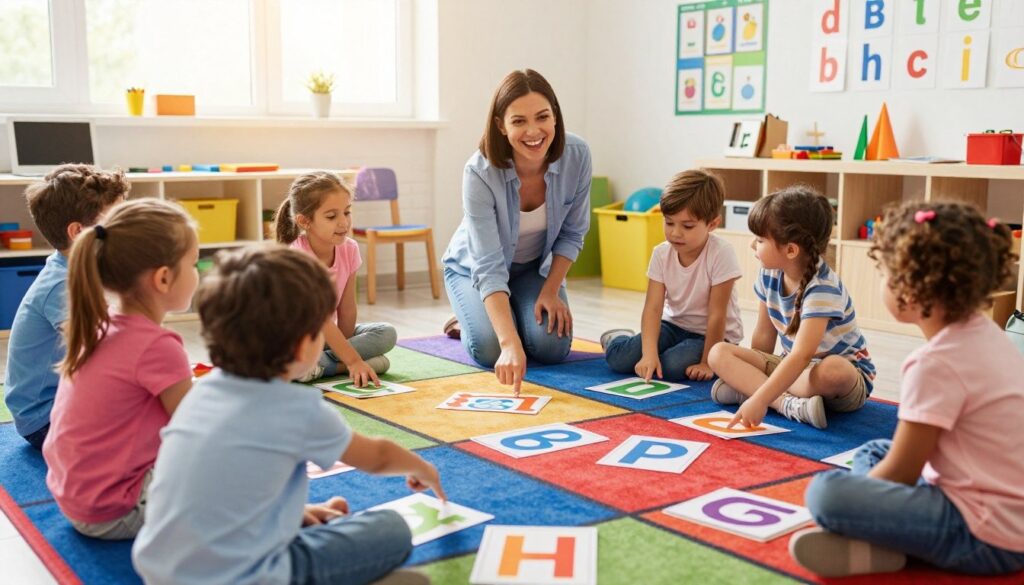
Letter recognition is a fundamental skill that precedes reading and writing. Engaging children in letter recognition games can make learning fun and interactive. These games can include alphabet tracing, letter scavenger hunts, and matching games.
Rhyming and Word Play
Rhyming and word play activities are essential for developing phonological awareness. These activities help children recognize the sounds within words, enhancing their ability to read and spell. Examples include singing rhyming songs, playing word-matching games, and creating silly rhymes.
| Activity | Age Group | Benefits |
| Storytelling | 3-5 years | Enhances vocabulary, comprehension, and imagination |
| Letter Recognition Games | 3-4 years | Develops alphabet knowledge and fine motor skills |
| Rhyming and Word Play | 4-5 years | Improves phonological awareness and language skills |
By incorporating these literacy and language building activities into daily routines, parents and educators can provide preschoolers with a strong foundation for future academic success.
Math and Number Concept Activities
Math activities for preschoolers are not just about counting; they’re about building a strong foundation for future mathematical understanding. Engaging in various math-related activities helps children develop essential skills that will benefit them throughout their educational journey.
Counting Games and Activities
Counting games are a fun and interactive way to introduce children to basic numeracy. Activities such as number scavenger hunts, counting blocks, or singing number songs can captivate young learners and enhance their counting skills. For instance, a simple game of “What’s Missing?” where numbers are laid out in sequence and one is hidden, encourages children to recognize and recall numbers.
Shape and Pattern Recognition
Understanding shapes and patterns is crucial for developing problem-solving skills. Activities like sorting objects by shape, creating patterns with blocks or toys, and playing “I Spy” with shapes can be both entertaining and educational. These exercises help children recognize and replicate patterns, a fundamental aspect of math.
Measurement and Comparison Exercises
Measurement and comparison activities introduce children to the concept of quantities and relative sizes. Simple exercises such as comparing the lengths of objects, measuring the capacity of containers, or ordering objects by size can be conducted using everyday items. For example, filling different sized containers with water and comparing their capacities teaches children about volume.
By incorporating these math and number concept activities into daily routines, parents and educators can provide children with a solid foundation in math. It’s essential to make these activities engaging and relevant to the child’s everyday life to foster a positive attitude towards learning math.
Science and Discovery Activities for Young Minds
Simple science experiments and nature exploration can ignite a lifelong love for learning in children. Engaging young minds in science and discovery activities not only fosters curiosity but also lays the foundation for critical thinking and problem-solving skills.
Simple Science Experiments
Conducting simple science experiments is an excellent way to introduce children to basic scientific concepts. For instance, a homemade lava lamp experiment using oil, water, food coloring, and Alka-Seltzer tablets can teach density and buoyancy. Another example is creating a volcano using baking soda and vinegar, demonstrating chemical reactions.
- Making slime to learn about polymers
- Growing crystals to understand geology
- Creating a solar oven to learn about renewable energy
Nature Exploration Activities
Nature exploration activities encourage children to appreciate and understand the natural world. Organizing a nature scavenger hunt can help children identify different plants, insects, and animals. Creating a backyard or classroom garden teaches children about photosynthesis, ecosystems, and the importance of nutrition.
Nature Journalingis another effective activity where children record their observations of the natural world, fostering a deeper connection with nature.
Cause and Effect Learning Games
Cause and effect learning games are crucial for developing critical thinking skills in children. Activities such as dropping different objects to see how they fall, or using a domino setup to demonstrate chain reactions, help children understand causality.
“The important thing is not to stop questioning. Curiosity has its own reason for existence.” – Albert Einstein
By engaging in these science and discovery activities, children not only learn scientific concepts but also develop essential skills that benefit them across various aspects of life.
Creative Arts and Expression Activities
Creative arts and expression activities play a significant role in fostering imagination in young children. These activities not only enhance their creativity but also contribute to their overall development.
Engaging in creative arts allows preschoolers to explore different mediums and techniques, developing their fine motor skills and hand-eye coordination. It also provides an outlet for self-expression, helping build confidence and self-esteem.
Open-Ended Art Projects
Open-ended art projects are an excellent way to encourage creativity. These projects allow children to experiment with various materials like paints, crayons, and clay, without the constraint of creating a specific outcome.
- Painting and drawing activities
- Crafting with different textures
- Collage making
Music and Rhythm Activities
Music and rhythm activities introduce children to the world of sound and rhythm, enhancing their auditory skills and creativity.
- Singing nursery rhymes
- Playing simple musical instruments
- Movement activities to music
Dramatic Play and Pretend Scenarios
Dramatic play and pretend scenarios foster imagination and role-playing skills, helping children develop socially and emotionally.
- Setting up pretend play scenarios
- Using props and costumes
- Encouraging storytelling through play
These creative activities not only bring joy but also play a crucial role in the development of preschoolers. By incorporating them into daily routines, parents and educators can help children develop their creative potential.
| Activity Type | Benefits | Examples |
| Open-Ended Art | Enhances creativity and fine motor skills | Painting, drawing, crafting |
| Music and Rhythm | Develops auditory skills and creativity | Singing, playing instruments, movement to music |
| Dramatic Play | Fosters imagination and social-emotional development | Pretend play scenarios, using props and costumes |
Adapting Preschool Activities for Different Learning Styles
Recognizing the diverse learning styles among preschoolers is key to creating an inclusive and effective learning environment. Children have unique ways of processing information, and understanding these differences can help tailor activities to meet their individual needs.
Activities for Visual Learners
Visual learners benefit from activities that incorporate images, colors, and visual aids. Some effective strategies include:
- Using pictures and flashcards to teach new concepts
- Creating art projects that involve different textures and colors
- Watching educational videos together
Activities for Kinesthetic Learners
Kinesthetic learners thrive in environments where they can engage in hands-on activities. Some ideas include:
- Conducting simple science experiments
- Engaging in play dough and clay modeling
- Participating in dance and movement activities
Activities for Auditory Learners
Auditory learners respond well to activities that involve sound and music. Some suggestions are:
- Listening to storytelling sessions
- Engaging in music and rhythm activities
- Playing sound-based games, like “What’s the Sound?”
By incorporating a mix of these activities, preschool programs can cater to the diverse learning styles of their students, ensuring a more inclusive and engaging educational experience.
| Learning Style | Activity Examples | Benefits |
| Visual Learners | Pictures, flashcards, art projects | Enhances memory, improves recognition |
| Kinesthetic Learners | Science experiments, play dough, dance | Develops fine motor skills, encourages exploration |
| Auditory Learners | Storytelling, music, sound games | Improves listening skills, fosters creativity |
Conclusion: Fostering a Love of Learning Through Play
Play-based learning is a powerful tool for fostering a love of learning in children. By incorporating a variety of engaging activities into daily routines, parents and caregivers can support overall development and encourage a lifelong passion for discovery.
The activities outlined in this article, from sensory play and fine motor skill development to literacy and math concept building, provide a comprehensive foundation for young learners. By adapting these activities to different learning styles, caregivers can ensure that each child receives a well-rounded education.
Fostering learning through play is not just about providing entertainment; it’s about creating a nurturing environment that promotes cognitive, social-emotional, and physical growth. By continuing to provide play-based learning opportunities, we can help children develop a love of learning that will serve them well throughout their lives.
FAQ
What are some engaging preschool activities for kids?
Some engaging preschool activities include sensory play, fine motor skill development activities like beading and lacing, gross motor activities such as indoor movement games, and literacy and language building activities like storytelling and book-based activities.
Why are early childhood activities important for development?
Early childhood activities are crucial for a child’s development as they provide cognitive benefits, promote social-emotional growth, and enhance overall physical fitness and motor control.
How can I create a balanced activity schedule for my preschooler?
To create a balanced activity schedule, consider your child’s age and developmental stage, and mix structured and unstructured play, including a variety of activities such as arts, music, and physical play.
What are some DIY sensory play activities I can try with my child?
You can create DIY sensory bins and tables, engage in texture exploration activities, and play scent and sound discovery games to stimulate your child’s senses.
How can I support my child’s fine motor skill development?
Engage your child in beading and lacing projects, cutting and pasting crafts, and play dough and clay modeling to improve their fine motor skills.
What are some gross motor activities suitable for preschoolers?
Indoor movement games, outdoor play structures and activities, and balance and coordination challenges are excellent gross motor activities for preschoolers.
How can I encourage my child’s literacy and language skills?
Engage your child in storytelling and book-based activities, letter recognition games, and rhyming and word play to build their literacy and language skills.
What are some math and number concept activities for preschoolers?
Counting games and activities, shape and pattern recognition exercises, and measurement and comparison activities are great ways to introduce math concepts to your child.
How can I adapt preschool activities for different learning styles?
Tailor activities to your child’s learning style by using visual aids for visual learners, hands-on experiments for kinesthetic learners, and music and storytelling for auditory learners.
What are some creative arts and expression activities for preschoolers?
Open-ended art projects, music and rhythm activities, and dramatic play and pretend scenarios are excellent ways to encourage creativity and self-expression in your child.
Why is play-based learning important for young children?
Play-based learning is essential as it fosters a love of learning, promotes overall development, and helps children develop critical thinking, problem-solving, and social skills.


Comments are closed