

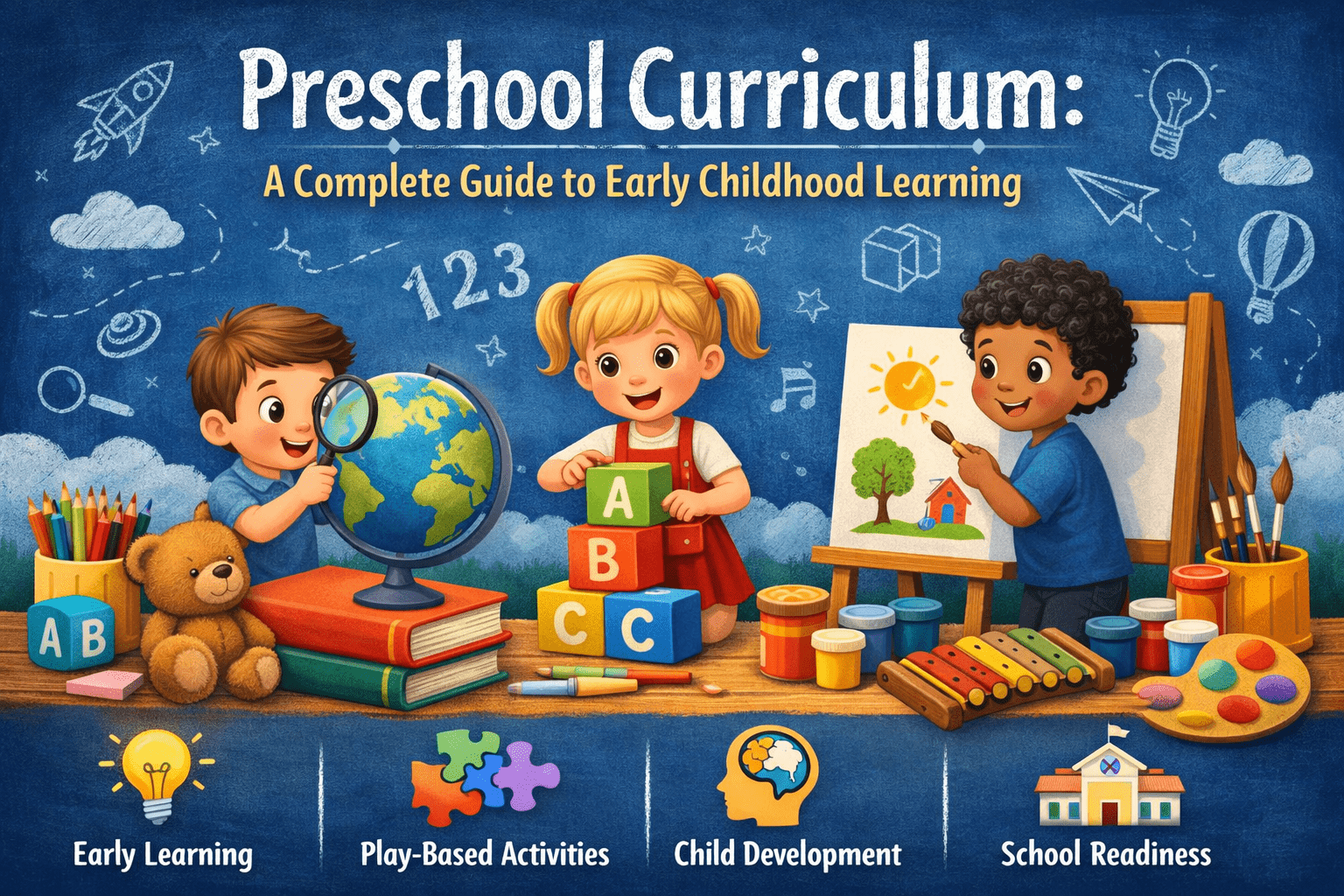
A preschool curriculum is the foundation of a child’s early learning journey. It provides a structured yet flexible framework that supports children’s cognitive, social, emotional, physical, and language development during their most crucial growth years. Designed for children between 2 and 6 years, a well-planned preschool curriculum ensures learning happens naturally through play, exploration, and guided activities.
Unlike traditional academic systems, preschool education focuses on nurturing curiosity, creativity, independence, and confidence—skills that prepare children not only for school but for life.
What Is a Preschool Curriculum?
A preschool curriculum is a planned set of learning experiences that outlines what children should learn, how they learn, and how progress is supported. It blends structured teaching with play-based learning, allowing children to develop skills at their own pace.
The curriculum is not limited to alphabets and numbers. It also includes:
- Social interaction
- Emotional awareness
- Motor skill development
- Communication skills
- Creative expression
A strong preschool curriculum respects each child’s individuality while encouraging holistic growth
Why Is Preschool Curriculum Important?
Early childhood is a critical brain development stage. During these years, children absorb information rapidly and form lifelong learning habits. A structured preschool curriculum:
- Builds strong learning foundations
- Encourages positive behavior and discipline
- Develops communication and listening skills
- Improves emotional regulation and social bonding
- Prepares children for formal schooling
Children who follow a balanced preschool curriculum often transition into kindergarten with greater confidence and adaptability.
Core Components of a Preschool Curriculum
1. Language and Literacy Development
This area focuses on helping children communicate effectively and develop early reading skills through:
- Alphabet recognition
- Phonics and sound awareness
- Storytelling and rhymes
- Vocabulary building
- Pre-writing activities
2. Early Mathematics
Mathematical thinking is introduced in simple, fun ways such as:
- Counting objects
- Number recognition
- Shapes and patterns
- Sorting and matching
- Comparing sizes and quantities
3. Cognitive Development
Cognitive skills help children think, reason, and solve problems. Activities include:
- Puzzles and games
- Memory-building exercises
- Cause-and-effect learning
- Logical thinking tasks
4. Social and Emotional Development
This component helps children understand themselves and others by learning:
- Sharing and cooperation
- Expressing emotions appropriately
- Following routines
- Building relationships
- Developing self-confidence
5. Physical Development
Physical activities support both:
- Gross motor skills (running, jumping, climbing)
- Fine motor skills (drawing, cutting, threading, grasping)
6. Art, Craft, and Creative Expression
Creative activities encourage imagination and self-expression through:
- Drawing and painting
- Craft activities
- Music and movement
- Role play and drama
7. Sensory and Experiential Learning
Hands-on experiences help children explore their environment using:
- Sand and water play
- Texture exploration
- Nature-based activities
- Practical life skills
Preschool Curriculum by Age Group
Playgroup Curriculum (2–3 Years)
At this stage, learning focuses on exploration and sensory experiences:
- Music and movement
- Sensory play
- Simple rhymes
- Social interaction
- Basic motor skills
Nursery Curriculum (3–4 Years)
Children begin structured learning with:
- Alphabet introduction
- Number awareness
- Creative art activities
- Communication development
- Group play
LKG Curriculum (4–5 Years)
This stage builds readiness skills through:
- Phonics basics
- Counting and patterns
- Writing readiness
- Problem-solving
- Cooperative learning
UKG Curriculum (5–6 Years)
Children are prepared for formal schooling with:
Play-Based Learning in Preschool Curriculum
Modern preschool curriculums follow a play-based learning approach, where children learn through meaningful play rather than rote memorization. This method:
- Reduces learning pressure
- Improves understanding and retention
- Encourages curiosity and creativity
- Supports emotional well-being
Play-based learning helps children enjoy education and develop a positive attitude toward learning.
Daily Routine in a Preschool Curriculum
A structured daily routine gives children a sense of security and predictability. A typical preschool day includes:
- Free play and arrival time
- Circle time and group interaction
- Learning activities
- Snack and rest time
- Outdoor play
- Creative sessions
Consistent routines help children develop discipline and time awareness.
How a Preschool Curriculum Supports School Readiness
A quality preschool curriculum prepares children for formal education by helping them:
- Follow instructions
- Sit and focus for longer periods
- Communicate confidently
- Understand basic academic concepts
- Adapt to classroom environments
School readiness is not about academic pressure—it’s about emotional, social, and cognitive preparedness.
How Parents Can Choose the Right Preschool Curriculum
Parents should look for a preschool curriculum that:
- Is age-appropriate
- Balances academics and play
- Focuses on overall development
- Encourages creativity and independence
- Maintains a safe and nurturing environment
A transparent and well-structured curriculum reflects a preschool’s commitment to quality education.
Conclusion
A well-designed preschool curriculum plays a crucial role in shaping a child’s early learning experiences. By focusing on holistic development, play-based learning, and age-appropriate activities, it builds a strong foundation for academic success and personal growth.
Choosing the right preschool curriculum ensures children grow into confident, curious, and capable learners, ready to explore the world with enthusiasm.



Comments are closed