


Introduction
Choosing a preschool is one of the first major decisions parents make about their child’s education. The right early-learning environment can help a child feel secure, build friendships, communicate confidently and develop a positive attitude towards learning. If you are looking for a preschool in Rajakilpakkam, you may find several options with different teaching approaches, facilities, timings and fee structures. Instead of choosing based only on distance or advertisements, take time to understand what each school offers and how well it suits your child.
A good preschool does more than prepare children to recognise letters and numbers. It gives them opportunities to explore, ask questions, play, express feelings and learn everyday skills. This checklist will help you compare preschool in Rajakilpakkam and make a thoughtful choice based on your family’s needs and your child’s development.
1. Look for a Safe, Welcoming Environment
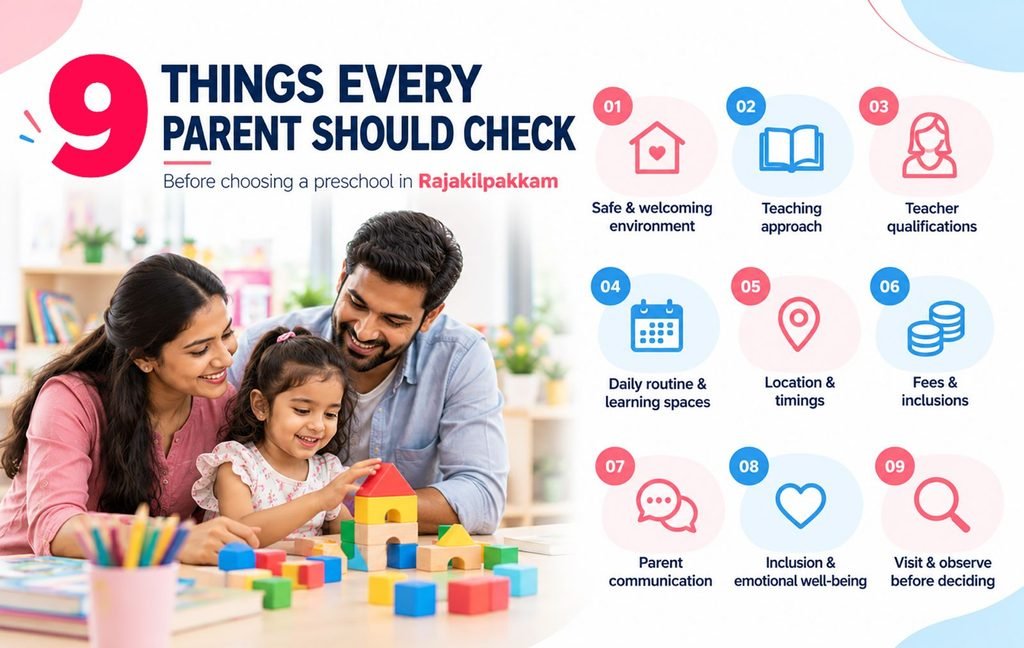
Safety should be the first item on your preschool in Rajakilpakkam checklist. During a visit, notice whether classrooms, play areas, washrooms and entry points are clean, organised and suitable for young children. Ask how the school manages visitor entry, child pick-up and emergency situations. Find out whether staff members know the school’s safety procedures and how parents are contacted if a child becomes unwell or an unexpected issue occurs.
Observe the atmosphere, too. Children should have room to move, age-appropriate furniture and materials they can reach safely. Check that toys and learning resources are in good condition and that outdoor play spaces are supervised. A warm welcome from teachers and staff can also tell you something about the school’s culture. Children need to feel comfortable enough to explore while knowing that a trusted adult is nearby.
Do not hesitate to ask direct questions. A responsible preschool should be willing to explain its safety practices clearly rather than offering only general assurances.
2. Understand the Teaching Approach
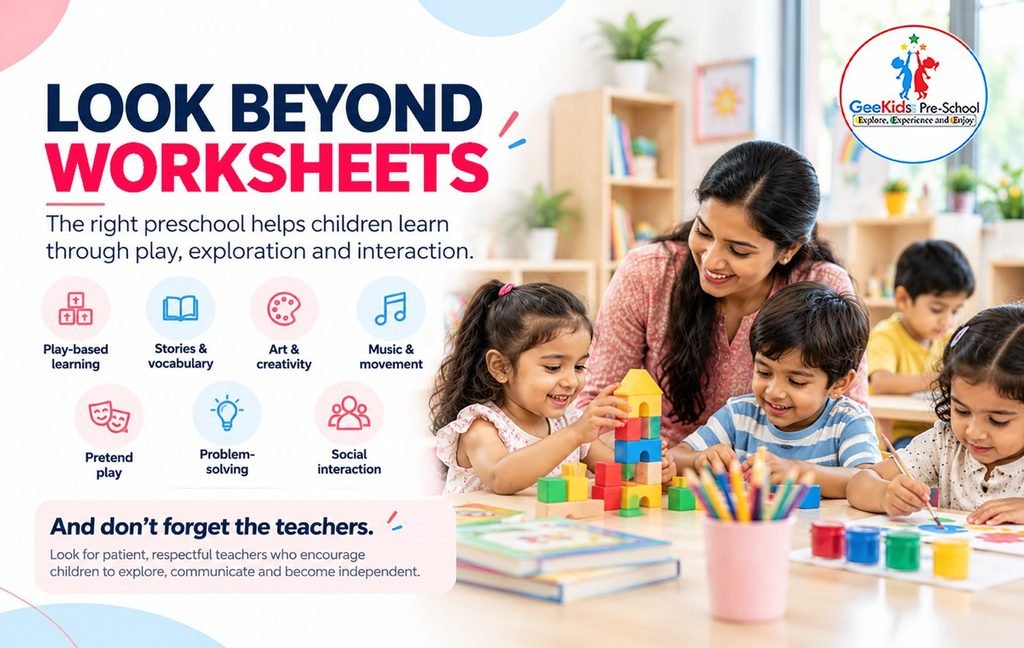
Preschool in Rajakilpakkam learning should be appropriate for a child’s age and stage of development. Ask how teachers balance early literacy and numeracy with movement, music, stories, art, pretend play and social interaction. Young children learn through a variety of experiences, so a classroom that relies only on worksheets or memorisation may not offer enough opportunities to investigate and practise new skills.
Play-based learning can help children develop language, creativity, problem-solving and cooperation. For example, building with blocks can introduce patterns, balance and early mathematical thinking. Story time encourages listening and vocabulary, while role-play gives children a chance to practice conversation and understand different perspectives. Art activities can strengthen fine-motor control and allow children to make choices.
Ask for examples of a typical day. Find out how teachers introduce new concepts, support children who need extra time and encourage children who are ready for a challenge. A good preschool in Rajakilpakkam should be able to describe its teaching philosophy in practical terms, not just use educational buzzwords.
3. Check Teacher Qualifications and Interaction
Teachers play a central role in a child’s early school experience. Ask about staff training, experience with the relevant age group and opportunities for professional development. Also ask how many children are in each class and how the school ensures that children receive individual attention.
When visiting, observe how adults speak to children. Do they listen patiently, use respectful language and explain expectations calmly? Do they encourage children to try tasks independently, or do they complete everything for them? Children may take time to settle into preschool, and compassionate teachers understand that separation, shyness and occasional tears can be part of the transition.
Ask how teachers respond to disagreements, frustration or behaviour that disrupts the class. Positive guidance helps children name feelings, practise taking turns and learn boundaries without humiliation. The goal is not a classroom where children never make mistakes; it is a classroom where mistakes become opportunities to learn.
4. Review the Daily Routine and Learning Spaces
A predictable routine can help young children feel secure. Ask how the Preschool organises arrival, free play, group activities, outdoor time, meals or snacks, rest and departure. The routine should provide structure while remaining flexible enough to respond to children’s needs.
Look at the learning spaces. Are there books, puzzles, building materials, pretend-play items, art supplies and opportunities for sensory exploration? Are children able to move between activities without excessive waiting? Outdoor play matters because running, climbing, balancing and exploring support physical development and give children a chance to practise cooperation.
Ask whether the school includes music, movement, storytelling, nature observation and practical life skills. These activities can support development in ways that are not always visible in a worksheet. A thoughtfully arranged classroom invites children to participate, make choices and learn by doing.
5. Consider Location, Timings and Transport
Convenience matters because preschool is part of the family’s everyday routine. Consider the distance from home or work, traffic during drop-off and pick-up, school timings and the availability of transport if you need it. A nearby preschool in Rajakilpakkam may reduce travel time and make it easier to attend parent meetings or collect your child when necessary.
If transport is offered, ask about supervision, pick-up procedures, route planning and how delays are communicated. Confirm the exact start and end times and ask what happens if a parent is late. Families should understand the school’s policies before admission rather than relying on assumptions.
Also think about your child’s energy levels. A long commute or schedule that conflicts with sleep and meals may make the transition harder. Choose a practical arrangement that supports your child’s well-being as well as your work and family commitments.
6. Compare Fees and What They Include
Preschool fees are important, but the lowest price is not automatically the best value, and a higher fee does not guarantee better learning. Request a written breakdown of admission charges, tuition, activity fees, materials, uniforms, transport and any additional costs. Ask whether fees are payable monthly, term-wise or annually, and clarify the refund policy if plans change.
Find out what learning materials, events, meals or enrichment activities are included. Ask whether parents need to purchase items separately and whether there are charges for optional programmes. Comparing the full cost helps you avoid surprises later.
Choose a school that fits your budget sustainably. Preschool is a partnership that works best when parents feel comfortable asking questions and understand the financial commitment.
7. Ask How Progress Is Shared with Parents
Children develop at different rates, so useful communication should explain more than whether a child is doing well or poorly. Ask how teachers share observations about language, social skills, independence, movement and early learning. Some schools use parent meetings, written updates, portfolios, photographs of activities or informal conversations.
A constructive update might explain that a child is beginning to take turns, enjoys listening to stories or needs more practice holding a pencil comfortably. Such details help parents understand progress and support learning at home without turning everyday life into formal lessons.
Ask how concerns are raised and how quickly parents can speak with the teacher. Good communication should be respectful, specific and two-way. Parents know their children in a different setting, and that information can help teachers offer more consistent support.
8. Observe Inclusion and Emotional Well-Being
Every child arrives with a unique personality, family background, language experience and learning pace. Ask how the Preschool in Rajakilpakkam helps new children settle in and how it supports children who are quiet, energetic, hesitant or learning to communicate their needs. A welcoming preschool respects differences and avoids comparing children unnecessarily.
Find out how teachers encourage sharing, turn-taking, empathy and independence. Children should have opportunities to make friends while also being allowed to play alone at times. Ask how the school handles food preferences, allergies or other individual needs where relevant, and what information families should provide before the child starts.
The emotional environment is just as important as the physical classroom. Children should be treated with dignity, and parents should feel able to discuss concerns openly.
9. Visit, Ask Questions and Trust Your Observations
A website or brochure can help you shortlist schools, but an in-person visit gives you a better sense of daily life. If possible, arrange a visit during normal school hours and ask whether you can observe a classroom activity. Notice whether children appear engaged, whether teachers respond to them and whether the environment feels organised without being unnecessarily rigid.
Prepare a short list of questions about safety, curriculum, staff, class size, fees, communication and settling-in support. Speak with the school administration and, where possible, learn from other parents. Reviews can be useful, but individual experiences differ, so consider several sources rather than relying on one comment.
After each visit, write down what you liked, what concerned you and which questions remain unanswered. Comparing schools while your impressions are fresh can make the decision easier.
Conclusion: Choose the Best Fit for Your Family
Finding the right preschool in Rajakilpakkam means looking beyond a building, a timetable or a list of activities. Focus on safety, caring teachers, developmentally appropriate learning, a balanced routine, clear communication and a practical fit for your family. Visit shortlisted schools, ask specific questions and observe how adults interact with children.
There is no single preschool that is perfect for every child. The best choice is one where your child can feel secure, explore with curiosity and gradually build confidence and independence. A thoughtful decision now can help make the first steps into education a positive experience for both your child and your family. Do Visit Preschool in Rajakilpakkam.

Comments are closed