


Introduction
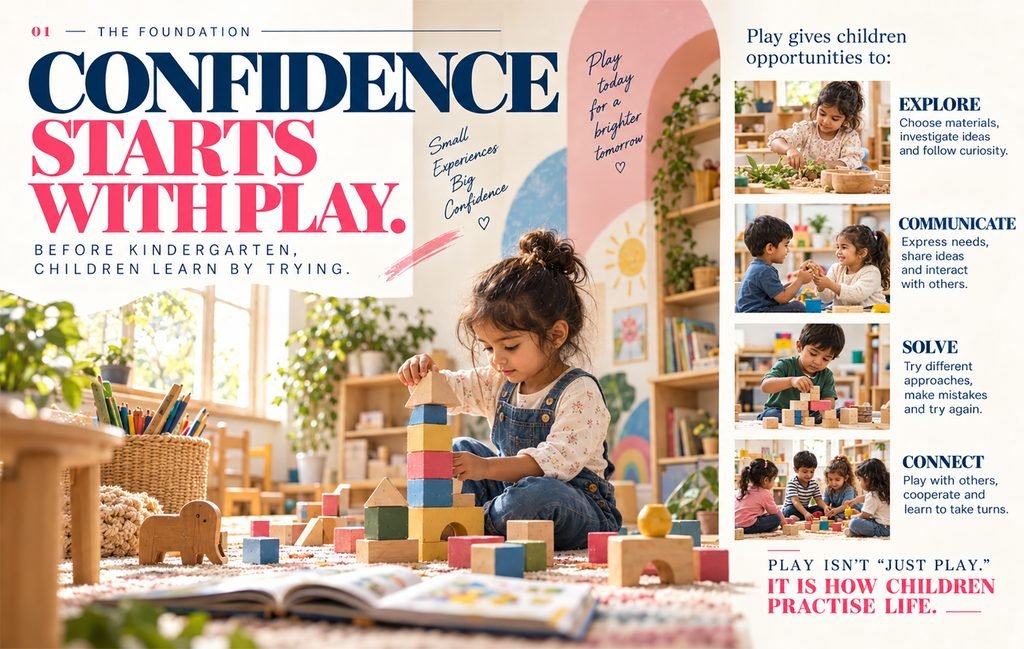
Confidence is an important part of getting ready for kindergarten. A confident child is not a child who never feels shy, makes mistakes or asks for help. Instead, confidence grows when children feel safe enough to try, explore, communicate and keep going after something proves difficult. Play based learning preschool gives young children regular opportunities to practise these skills in a meaningful and enjoyable way.
Before kindergarten, children learn through more than formal lessons. Building with blocks, pretending to run a shop, listening to stories, painting, singing and playing outdoors can all support development. These experiences help children make choices, solve small problems, express feelings and cooperate with others. Understanding how play-based learning works can help parents recognise the value of play at home and in a preschool programme.
What Is Play-Based Learning Preschool?
Play based learning preschool uses children’s natural curiosity as a starting point for development. Children explore materials, invent ideas, ask questions and interact with others while adults prepare a safe environment and offer guidance. Some play is child-led, allowing children to choose what interests them. Other activities are guided by a teacher who introduces a challenge, asks a question or helps children notice a pattern.
For example, a teacher might provide blocks and ask children how they could build a bridge for toy animals. Children can experiment with different shapes, compare results and try again if the structure falls. They are practising problem-solving, language, coordination and persistence without needing a formal worksheet.
Play based learning preschool does not mean children are left without structure. Skilled teachers plan experiences that match children’s developmental needs and observe how they participate. The aim is to make learning active, purposeful and enjoyable.
1. Play Gives Children Safe Chances to Try
Confidence develops through experience. When children are invited to try manageable tasks, they discover that their actions can make a difference. A child might choose a puzzle, attempt to fit the pieces and change strategies when the first attempt does not work. Completing the task can bring satisfaction, while the process teaches that effort matters.
Adults can support this by offering encouragement without taking over. Instead of immediately fixing a problem, ask, “What could you try next?” or “Would you like a hint?” Give children enough time to experiment and make mistakes. If an activity is too difficult, simplify it so they can experience progress.
The goal is not to praise every action automatically. Specific feedback is more useful: “You tried turning the piece until it fitted” helps children notice their own strategy. Over time, repeated experiences of trying, adjusting and succeeding can help children approach unfamiliar tasks with greater confidence.
2. Pretend Play Builds Communication and Social Confidence
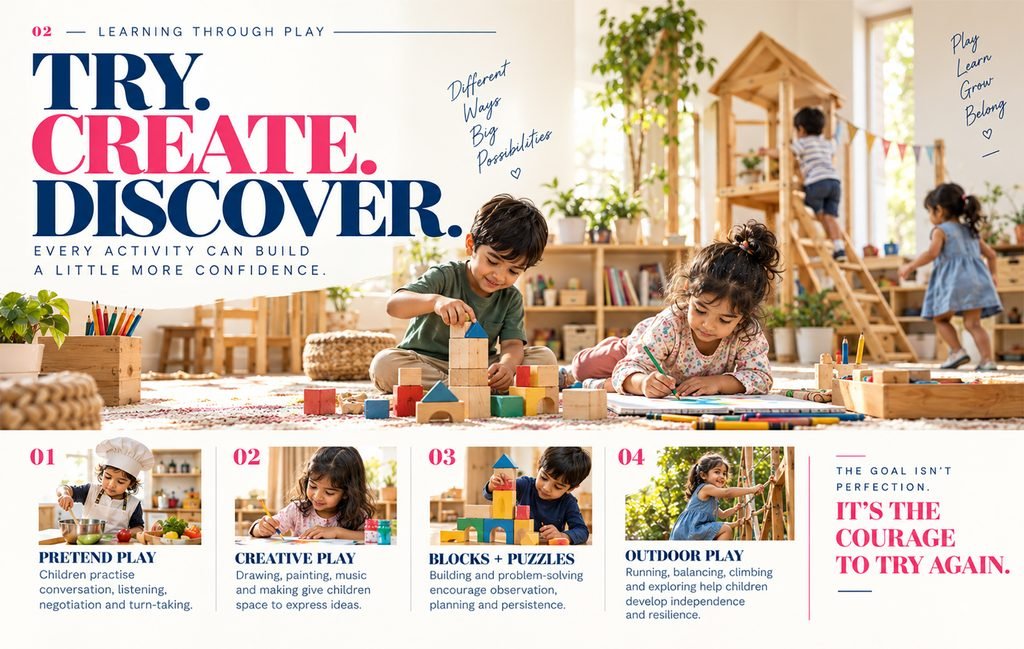
Pretend play allows children to explore familiar roles and imagine new situations. A group may pretend to run a restaurant, hospital, shop or bus station. As they decide who will play each role, children practise conversation, negotiation, listening and turn-taking.
A child who is quiet in a large group may feel more comfortable speaking through a puppet or taking a small role in a familiar pretend game. Another child may learn to ask a classmate for an item instead of grabbing it. These small interactions give children practice in communicating needs and responding to others.
Adults can extend pretend play by adding open-ended questions or materials. “What might the customer ask for?” or “How could we help the patient?” can introduce new vocabulary and encourage flexible thinking. Avoid directing every detail; children need room to create their own stories and solutions.
3. Creative Activities Encourage Self-Expression
Drawing, painting, music, movement and making objects from reusable materials give children ways to express ideas that they may not yet be able to explain fully in words. When a child chooses colours for a picture or invents movements for a song, they are practising decision-making and discovering personal preferences.
There is no need for every artwork to look alike. A display of identical crafts may be neat, but open-ended activities give children more opportunity to make choices and take ownership. Ask children to describe what they made rather than judging whether it is beautiful or correct. Their explanation may reveal a story, feeling or idea that an adult would not have expected.
Creative experiences can also teach children to tolerate uncertainty. The paper may tear, the paint may mix into an unexpected colour or the first idea may not work. With supportive guidance, children learn that a result can change and that trying again is part of creating.
4. Blocks, Puzzles and Games Develop Problem-Solving
Construction toys, matching games, puzzles and simple board games help children explore cause and effect. When a tower falls, a child can try a wider base. When a puzzle piece does not fit, they can rotate it or search for another place. These activities encourage observation, planning and persistence.
They also give children a chance to experience frustration in manageable situations. Adults can acknowledge the feeling—“That is tricky”—and help children break a task into smaller steps. The intention is not to remove every challenge, but to help children discover ways to handle it.
Group games add another layer of learning. Children practise following simple rules, waiting for a turn and coping with winning or losing. Before kindergarten, these everyday experiences can make classroom routines feel more familiar.
5. Outdoor Play Supports Independence and Resilience
Outdoor play offers opportunities to run, balance, climb, observe nature and test physical skills within safe boundaries. As children learn how their bodies move, they may become more comfortable trying new activities. They also practise judging space, coordinating movements and adjusting their actions.
Outdoor environments can invite curiosity. Children may compare leaves, watch insects, notice clouds or collect objects for sorting. A simple walk can lead to questions about size, colour, weather and living things. Adults can encourage observation while following safety rules and respecting nature.
Not every child will want to climb high or join a fast-moving game. Offer a range of choices and let children progress at their own pace. Confidence grows when children can participate without being pushed beyond what feels manageable.
6. Stories and Role-Play Help Children Understand Feelings
Stories introduce characters who feel excited, worried, disappointed, proud or lonely. Talking about these feelings helps children build emotional vocabulary and consider how different people might respond. Ask questions such as, “How do you think the character feels?” or “What could the friend do to help?”
Puppets and role-play can make emotional situations easier to explore. Children might practise greeting someone, asking to join a game or telling an adult that they need help. These rehearsals can give them words to use in real situations.
Adults should make room for a range of feelings. Confidence does not mean a child must always be cheerful or brave. Children feel more secure when adults listen calmly, name emotions without judgement and help them choose a safe next step.
7. Play Strengthens Early Language and Thinking
During play, children hear and use words for objects, actions, quantities, locations and feelings. Building a road may involve words such as long, short, beside, under and across. A pretend shop may introduce names of foods, counting, asking questions and explaining choices.
Adults can extend language by describing what children are doing, adding a new word or inviting them to explain their ideas. Give children time to respond instead of asking a rapid series of questions. Songs, rhymes, picture books and conversations throughout the day can support listening and expression.
Early thinking skills develop as children compare, sort, predict and test ideas. These foundations can support later learning in reading, mathematics and science. Formal worksheets are not the only way to introduce concepts; everyday play can provide rich opportunities for practice.
8. How Teachers Can Build Confidence Through Play
In a strong play-based classroom, teachers observe children carefully and plan experiences that offer both comfort and challenge. They make materials accessible, establish clear safety boundaries and help children enter activities without forcing them to participate in exactly the same way.
Teachers can support a hesitant child by beginning with a familiar activity, inviting a trusted classmate to join or offering a small role. They can help children who dominate a game practise listening and sharing. When disagreements occur, teachers guide children to explain what happened, hear another perspective and consider a solution.
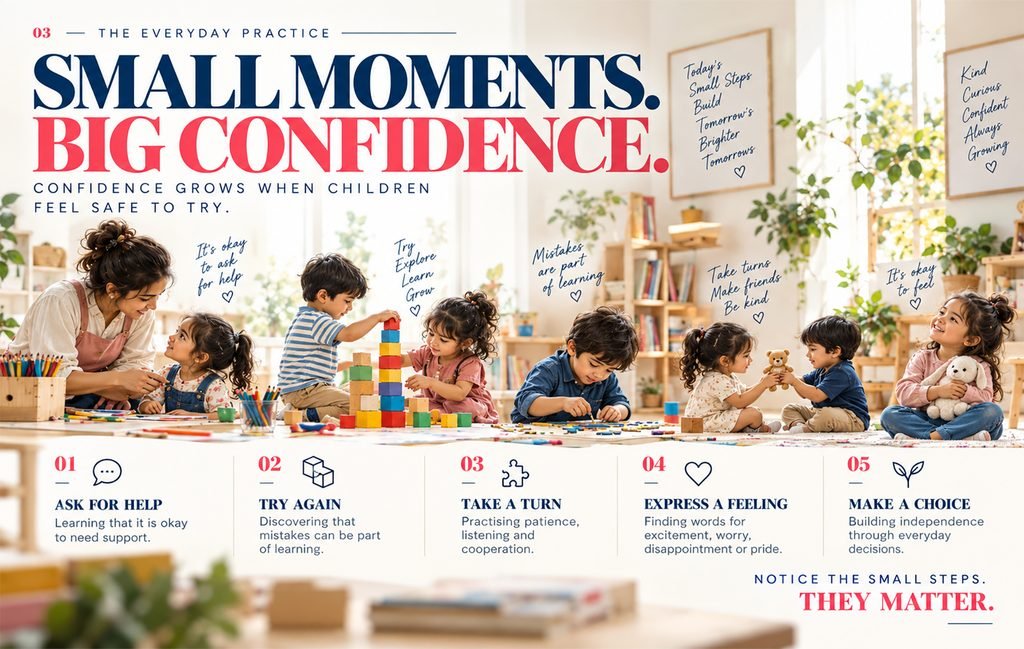
A good teacher recognises progress that may be easy to overlook: a child who asks for help, tries a new material, speaks in a group for the first time or returns to a difficult puzzle. These small steps can be meaningful signs of growing confidence.
9. Simple Ways Parents Can Encourage Play at Home
Parents do not need expensive toys or a complicated schedule to support play-based learning. Everyday materials such as cardboard boxes, containers, paper, blocks, crayons and picture books can inspire exploration when used safely. A box might become a bus, a shop counter or a house for toys.
Allow some unstructured time for children to choose what to do. Join their play when invited, follow their ideas and ask occasional open-ended questions. Try to resist correcting every detail or turning each game into a lesson. Children also benefit from opportunities to play independently while a caregiver remains appropriately available.
Daily routines can become playful learning experiences. Children can sort socks by colour, help set the table, count steps, water plants or choose a story. Keep expectations realistic and focus on participation rather than perfect results. Protect time for sleep, movement and family connection as well.
10. Helping Children Prepare for Kindergarten
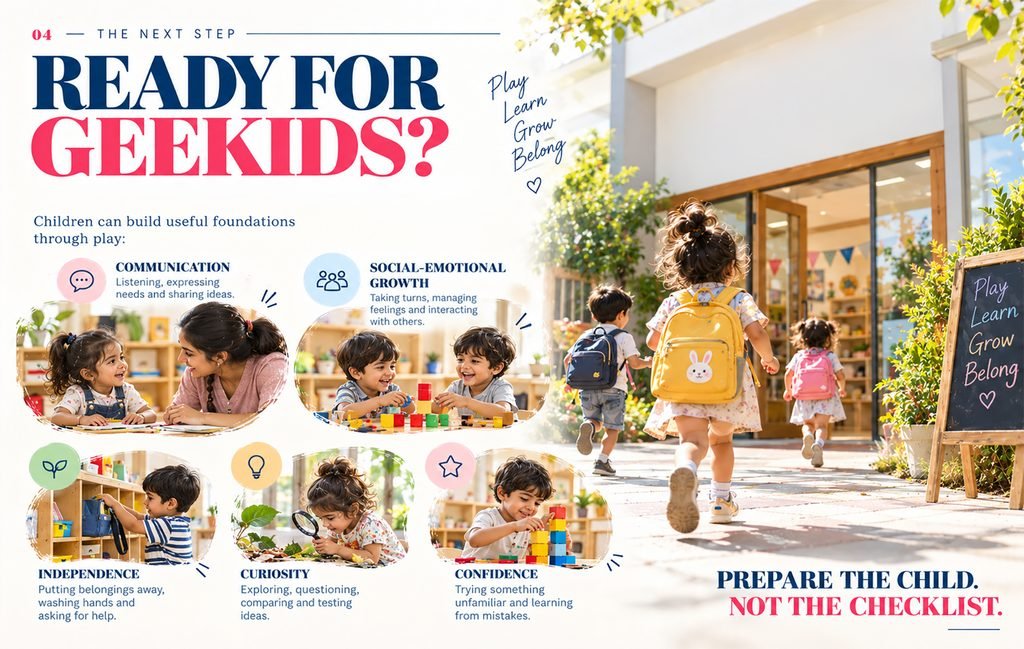
Kindergarten readiness includes communication, social-emotional development, physical skills, curiosity and increasing independence. Play can help children practise many of these areas, but readiness should not be reduced to a checklist of academic facts. Children do not need to master every letter or number before entering kindergarten.
Support useful routines such as putting belongings away, washing hands, asking for help, listening to a short story and following simple directions. Arrange opportunities to play with other children and practise taking turns. Talk about what a school day might involve and answer questions honestly.
If your child is worried, acknowledge the feeling and discuss what may help. Visit the school if an orientation is offered, practise the morning routine and build a predictable goodbye. Communicate with teachers about your child’s interests, strengths and support needs so that home and school can work together.
Conclusion: Confidence Grows Through Everyday Play
Play based learning preschool helps children build confidence by giving them repeated opportunities to make choices, explore ideas, communicate, solve problems and recover from small setbacks. It supports more than academic foundations: it also encourages independence, creativity, social understanding and emotional growth.
Before kindergarten, children benefit from adults who prepare safe environments, offer age-appropriate challenges and value effort as well as outcomes. Parents can support the same development through stories, pretend play, outdoor exploration, creative activities and relaxed time together.
Every child’s confidence develops at a different pace. Rather than comparing children or pushing them to perform, notice their small steps forward. When children feel safe to try, ask questions and learn from mistakes, they can approach the next stage of education with greater trust in themselves and in the adults who support them.
Comments are closed