


Introduction
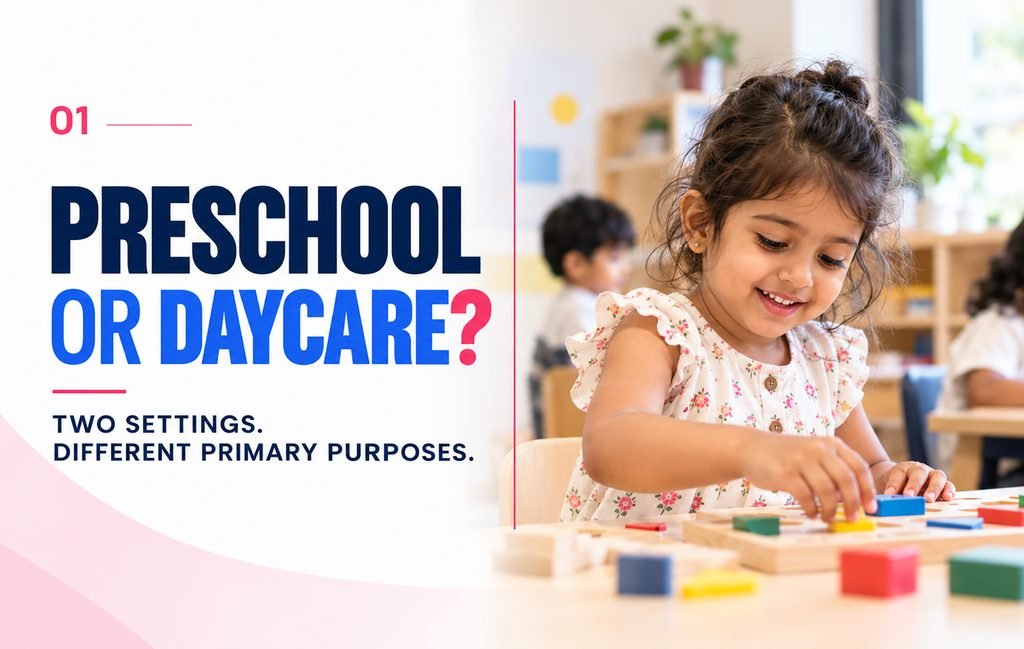
Parents comparing preschool vs daycare rajakilpakkam may notice that both services care for young children, but their main purposes can be different. Preschool generally focuses on early learning and social development through a planned programme. Daycare rajakilpakkam primarily provides supervised care for children while parents work or manage other responsibilities, although many daycare centres also include learning and play activities.
The right choice depends on your child’s age and needs, your work schedule, the hours of care required and the quality of the individual centre. Some families choose preschool only; others need daycare, and some use a preschool with extended-care options. Understanding the differences will help you ask better questions and choose an arrangement that supports both your child and your family.
What Is a Preschool?
A preschool offers an early-learning environment where children participate in activities designed to support communication, physical coordination, creativity, thinking and social development. The day may include stories, songs, art, pretend play, building activities, outdoor play and early exploration of letters, numbers, shapes and patterns.
Preschool usually follows a planned timetable and groups children by age or programme level. Teachers guide learning and help children practise classroom routines such as listening to instructions, sharing materials, taking turns and completing simple tasks. The aim is not to make very young children study like older students, but to help them build foundations for future learning.
When evaluating a preschool in daycare Rajakilpakkam, ask about the curriculum, teacher training, class size, daily schedule, safety practices and how progress is communicated to parents.
What Is Daycare?
Daycare rajakilpakkam provides a supervised place for children during the hours their parents or caregivers are unavailable. Depending on the centre, it may offer half-day, full-day or flexible care. Daily routines may include meals, rest, free play, outdoor time, stories and age-appropriate activities.
A daycare setting can be especially useful for parents who work full-time, have changing schedules or need reliable care beyond typical preschool hours. The quality of care depends on the staff, supervision, routines, facilities and the way children’s needs are met. Ask whether the centre has a structured activity plan, how rest and meals are handled, and how caregivers communicate with families.
Daycare rajakilpakkam should not be viewed simply as a place where children wait until parents return. A good centre provides attentive care, safe play and opportunities for development while respecting each child’s comfort and routine.
Key Differences Between Preschool and Daycare
The main difference is the primary purpose. Preschool is organised around early education and developmental experiences, while daycare is organised around supervision and care during the hours families need support. In practice, many centres combine elements of both, so the label alone is not enough to judge quality.
Preschool often follows a set academic-year calendar and a defined session, whereas daycare may offer longer hours and care throughout more of the working day. Preschool activities may be arranged around learning goals, while daycare routines may give greater emphasis to meals, rest, comfort and flexible play. However, both should provide safe surroundings, caring adults, age-appropriate activities and respectful communication.
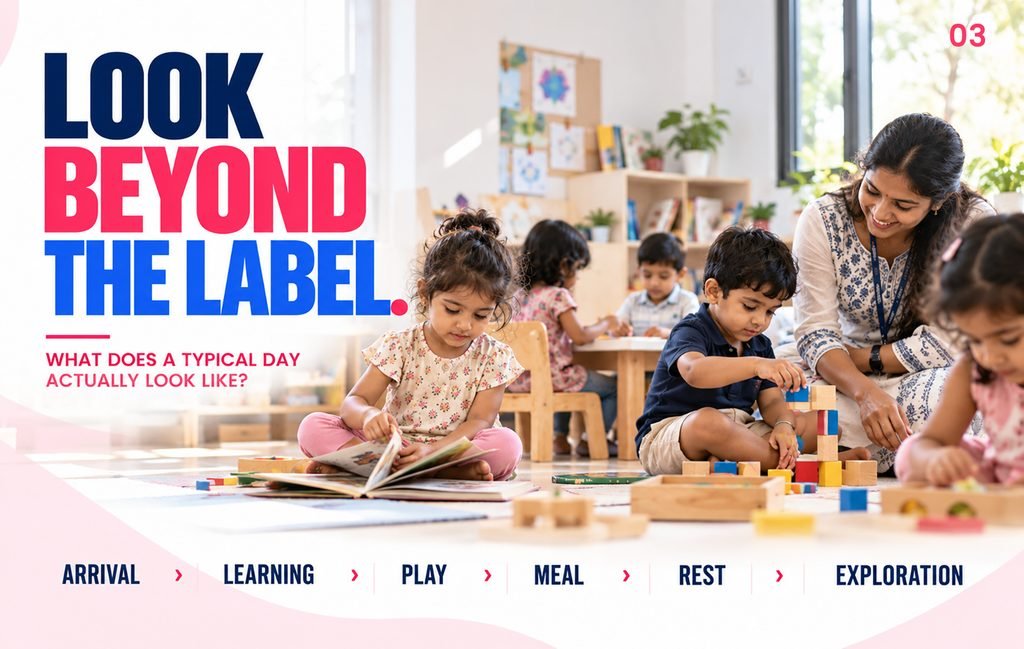
When comparing preschool vs daycare rajakilpakkam, ask each provider to describe what a typical day actually looks like. Confirm the exact hours, holiday arrangements, staff responsibilities and services included in the fee. These practical details are often more useful than broad descriptions on a brochure.
Which Option Fits Your Family’s Schedule?
Your daily schedule is an important starting point. If you need care for only a few hours and want your child to experience a structured early-learning programme, preschool may be suitable. If you need coverage for most of the workday, daycare may better match your requirements. If your family needs both, ask whether a preschool offers extended care or whether a separate daycare rajakilpakkam arrangement is available.
Think about commute time, drop-off and pick-up windows, work shifts and backup arrangements for unexpected delays. Ask what happens if you arrive late, whether extra hours are possible and how the centre handles public holidays or school closures. Confirm these policies before enrolling.
Avoid choosing a programme whose hours create constant stress for your family. A practical schedule makes it easier for your child to arrive calmly, eat and rest at appropriate times, and maintain a predictable routine.
Consider Your Child’s Age and Development
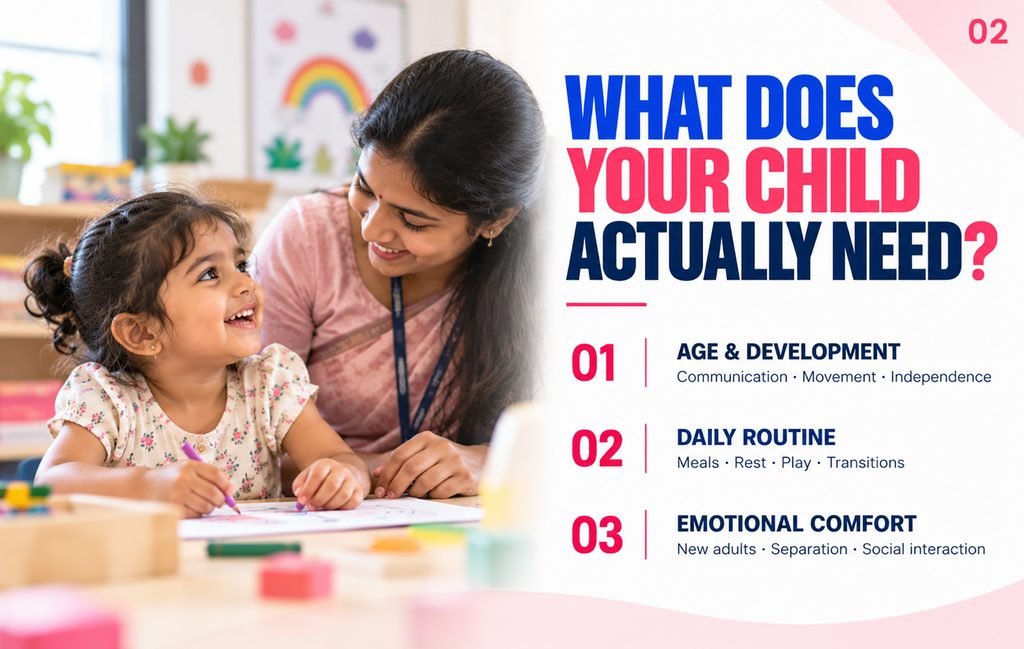
Children’s needs change as they grow. Younger children may need frequent comfort, rest, help with meals and close supervision. Older preschool-age children may be ready for more group activities, storytelling, cooperative play and opportunities to practise independence. There is no universal rule that every child of a certain age must follow the same arrangement.
Observe how your child responds to new adults, other children and short periods away from family. Some children enjoy group activities quickly; others need a gradual transition. Ask the centre how it supports separation anxiety, toileting or self-help routines where relevant, and children who need extra reassurance.
Readiness is not simply about knowing letters or numbers. It includes communication, emotional comfort, curiosity, movement and gradually learning everyday skills. Choose a setting that can respond to your child as an individual rather than expecting every child to adapt at the same speed.
Learning, Play and Social Development
Both preschool and daycare rajakilpakkam can offer valuable social experiences when the environment is well managed. Children may learn to take turns, express preferences, resolve small disagreements with adult support and become comfortable around peers. The important question is whether the centre provides meaningful interaction rather than leaving children without guidance.
In preschool, ask how teachers combine play with learning goals. In daycare, ask how caregivers plan activities throughout the day and prevent long periods of boredom or excessive screen use. Look for access to books, blocks, puzzles, pretend-play materials, art supplies, movement and outdoor exploration where appropriate.
Play is a central way young children discover how the world works. Building a tower introduces balance and problem-solving; a pretend shop encourages language and imagination; singing and movement develop listening and coordination. A quality setting makes room for both guided activities and child-led exploration.
Safety, Staff and Emotional Care
Safety should be non-negotiable in either setting. Ask how the centre manages entry and exit, confirms who is authorised to collect a child, supervises indoor and outdoor areas and responds to illness or emergencies. Check cleanliness, toilets, sleeping areas and the condition of toys and equipment. If meals are provided, ask about hygiene and how dietary needs or allergies are managed.
Find out about staff training, experience, supervision arrangements and the number of children each adult is responsible for. Observe whether adults respond patiently and respectfully. Children should be comforted when upset and guided through conflict without shaming or frightening them.
Ask how the centre records and reports incidents, communicates concerns and keeps parents informed. Clear procedures and open communication help build trust. If an answer is vague, ask for more detail before making a decision.
Fees and Services: Compare the Full Picture
Fees differ according to hours, facilities, staffing, meals, transport and activities. A preschool may charge for a defined session, while daycare rajakilpakkam fees may reflect longer hours or a full-day package. Some centres offer both services, with separate charges for extended care, meals, transport or enrichment activities.
Request a written fee schedule and clarify admission charges, deposits, materials, uniforms, late pick-up fees, holiday charges and refund terms. Ask what happens when a child is absent and whether fees are still payable. Compare the total cost for the care you actually need, not just the headline price.
A clear fee structure makes budgeting easier and helps prevent misunderstandings. Choose a centre that offers appropriate care within your budget rather than paying for services your family will not use.
Can You Combine Preschool and Daycare?
For some families, a combined arrangement is the most practical solution. A child may attend preschool during the learning session and stay for extended care afterward. This can reduce travel between locations and help maintain a familiar environment. However, the longer day should still include suitable opportunities for rest, meals, free play and comfort.
Ask whether the same staff supervise children throughout the day or whether responsibilities change between sessions. Find out how children move from classroom activities to lunch, rest or afternoon play. Check whether extended-care hours are optional and how the school communicates when a child seems tired or unsettled.
A combined programme should not simply extend formal lessons for several more hours. Young children need variety, movement and downtime. Make sure the full-day schedule is balanced and appropriate for your child’s age.
A Checklist for Visiting Centres in Rajakilpakkam
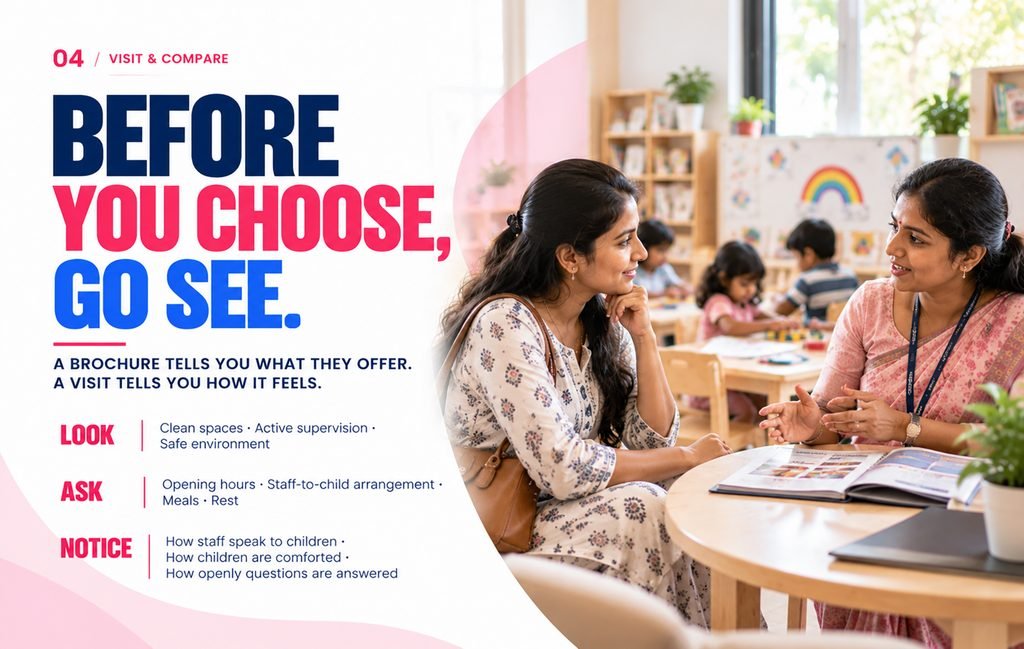
Before deciding, visit the centres you have shortlisted and ask to see the areas where your child will spend time. Observe whether spaces are clean, welcoming and organised. Notice how staff speak to children and whether supervision is active. Ask to see a sample schedule and request clear information about the curriculum or activity plan.
Questions worth asking include: What are the opening and closing times? How are children settled in? What is the staff-to-child arrangement? Are meals and rest provided? How are parents updated? What are the safety and pick-up procedures? What is included in the fee? How are concerns handled?
After each visit, record your impressions. Consider not only the facilities but also whether the centre’s approach feels respectful and whether staff answer questions openly. Other parents’ experiences can add context, but your own visit is essential.
Conclusion: Choose the Setting That Meets Your Needs
When deciding between preschool and daycare rajakilpakkam, start with the care hours your family needs, then compare the quality of learning, supervision, routines and communication. Preschool is generally centred on early learning; daycare is designed to provide care during parents’ working hours. Some providers combine both, making it possible to meet different needs in one setting.
The best choice is not necessarily the most expensive or the one with the most activities. It is the environment where your child is safe, treated with kindness, offered age-appropriate experiences and supported through transitions. Visit in person, ask specific questions and compare the complete daily routine before enrolling. A thoughtful choice can give your child a positive experience while helping your family manage everyday responsibilities with greater confidence.
Comments are closed